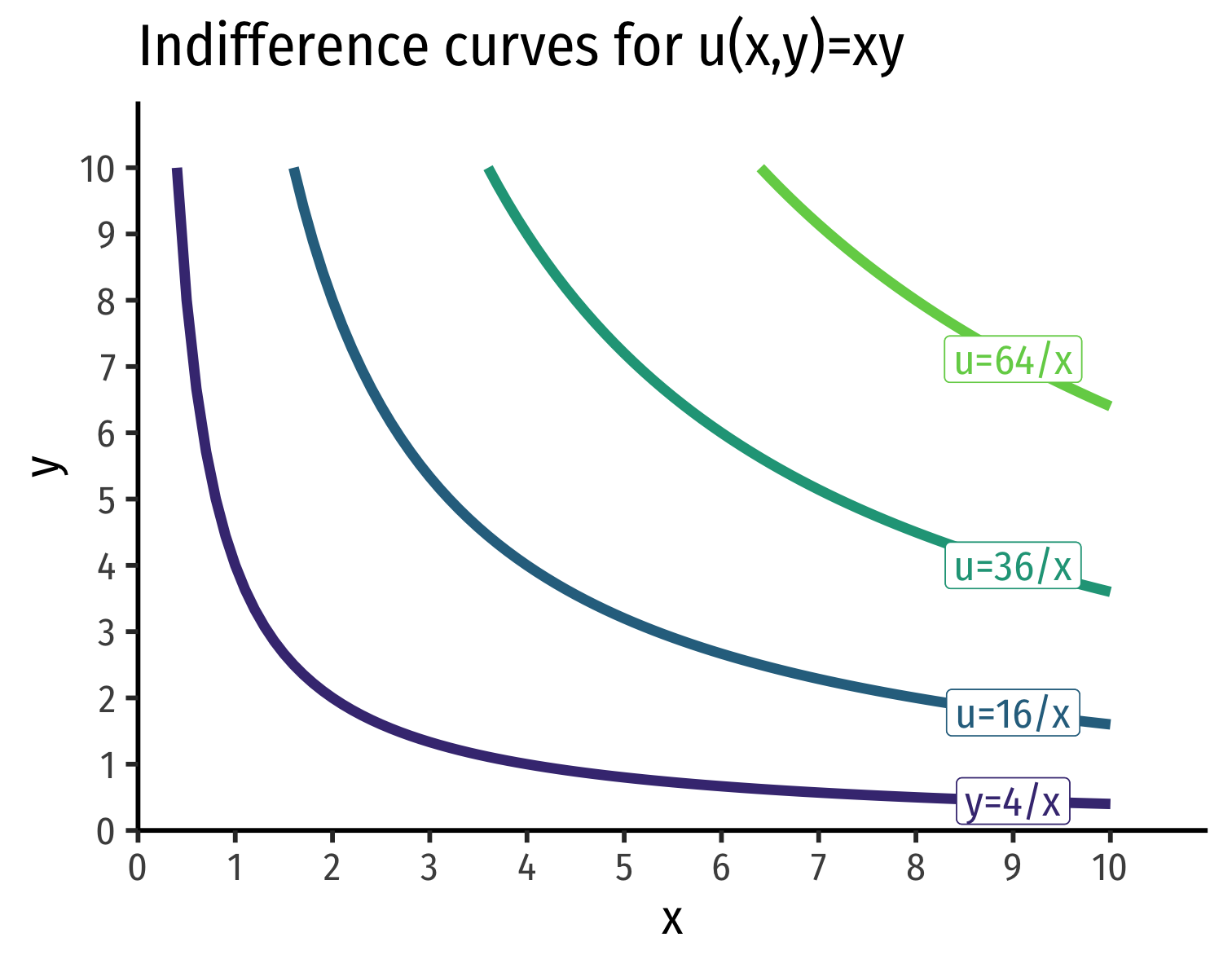
Utility Functions and Indifference Curves I
Two tools to represent preferences: indifference curves and utility functions
Indifference curve: all equally preferred bundles ⟺ same utility level
Each indifference curve represents one level (or contour) of utility surface (function)

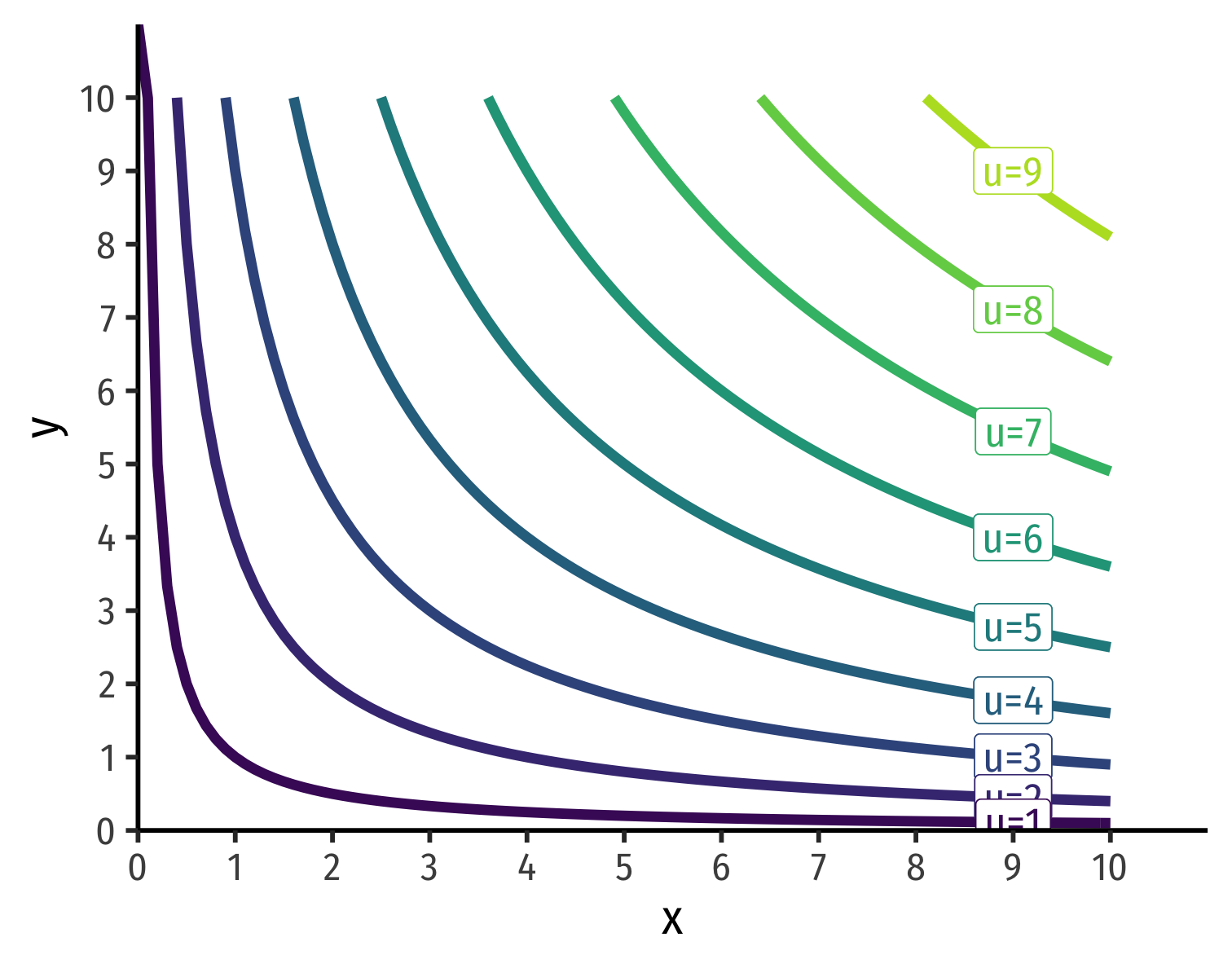
Utility Functions and Indifference Curves II
3-D Utility Function: u(x,y)=√xy
2-D Indifference Curve Contours: y=u2x
MRS and Marginal Utility I
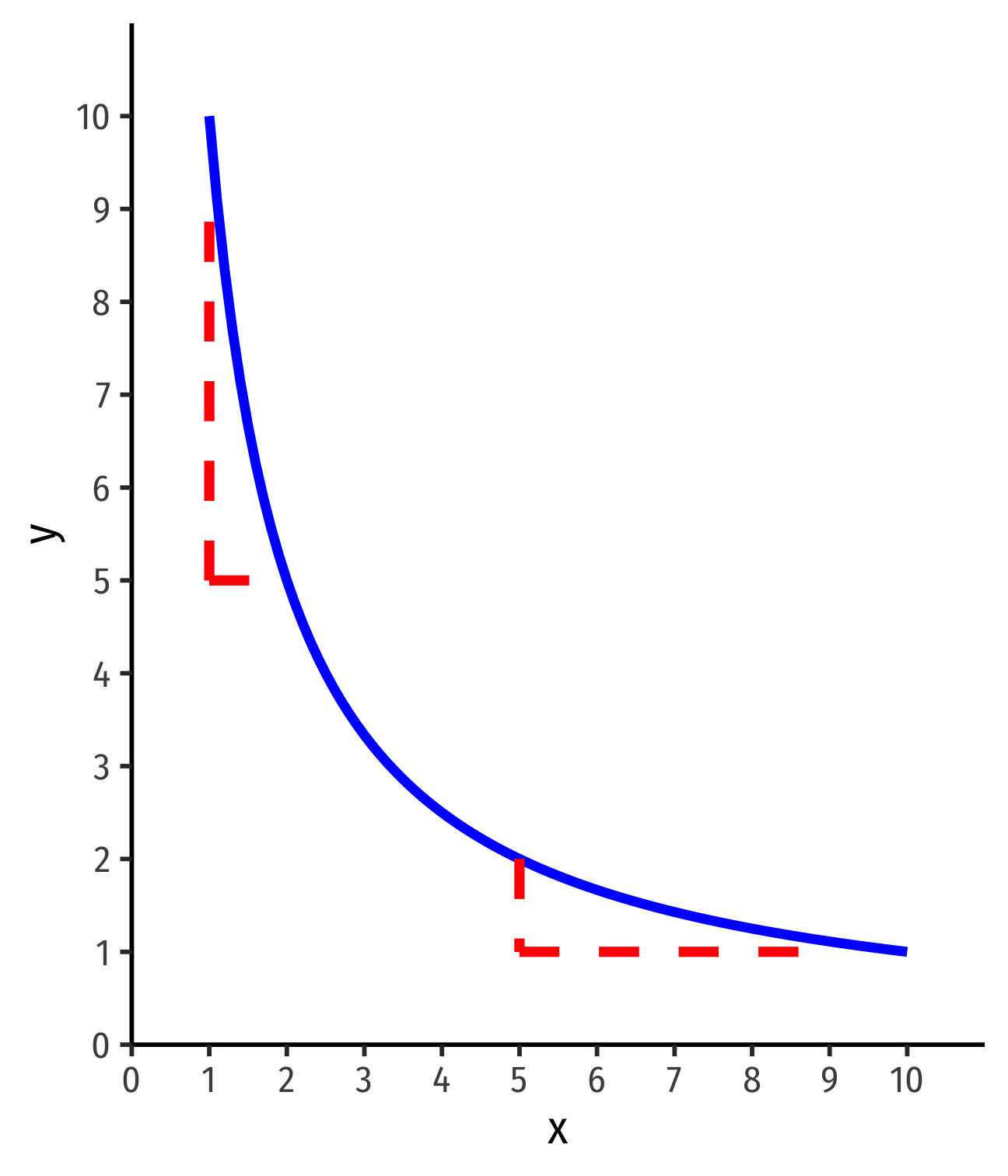
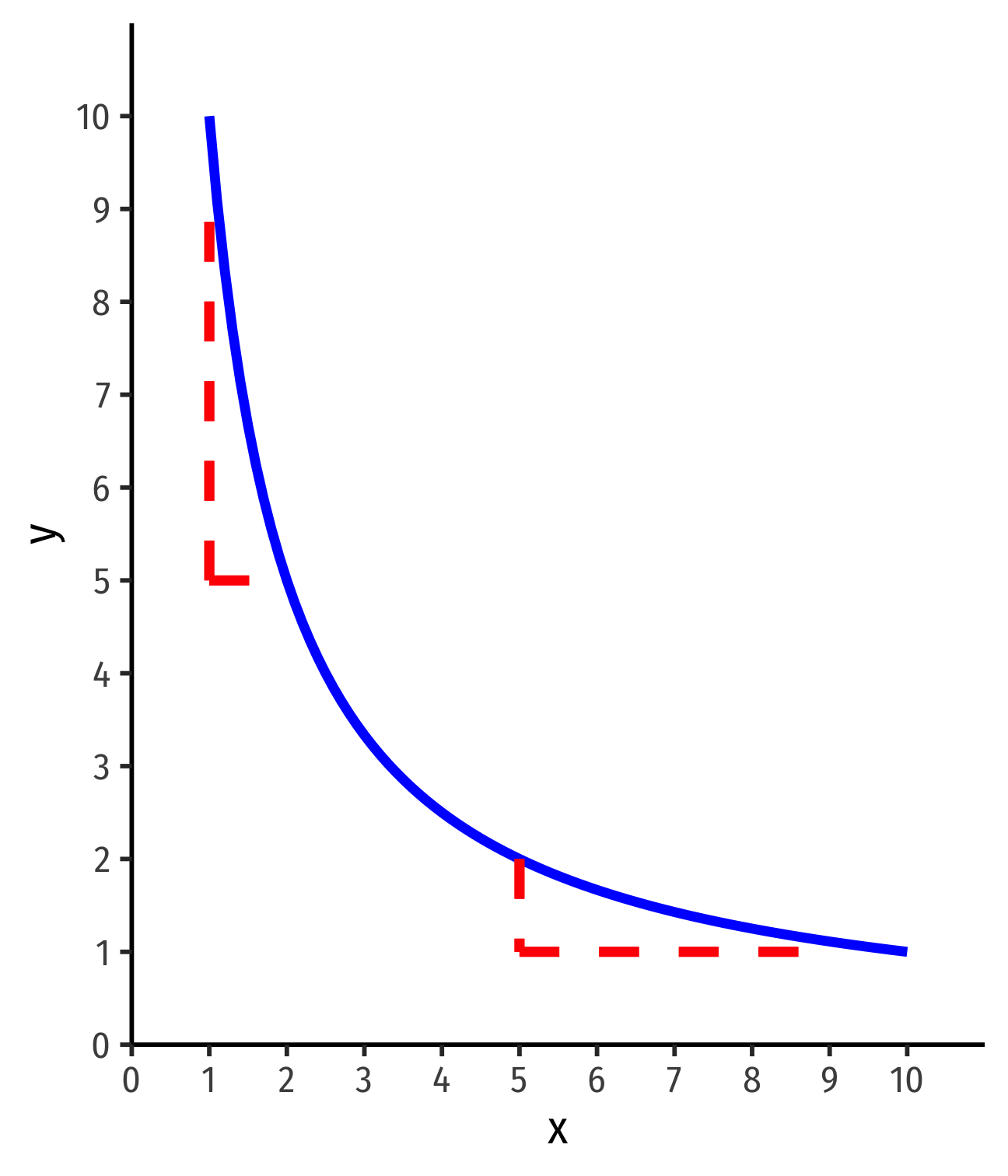
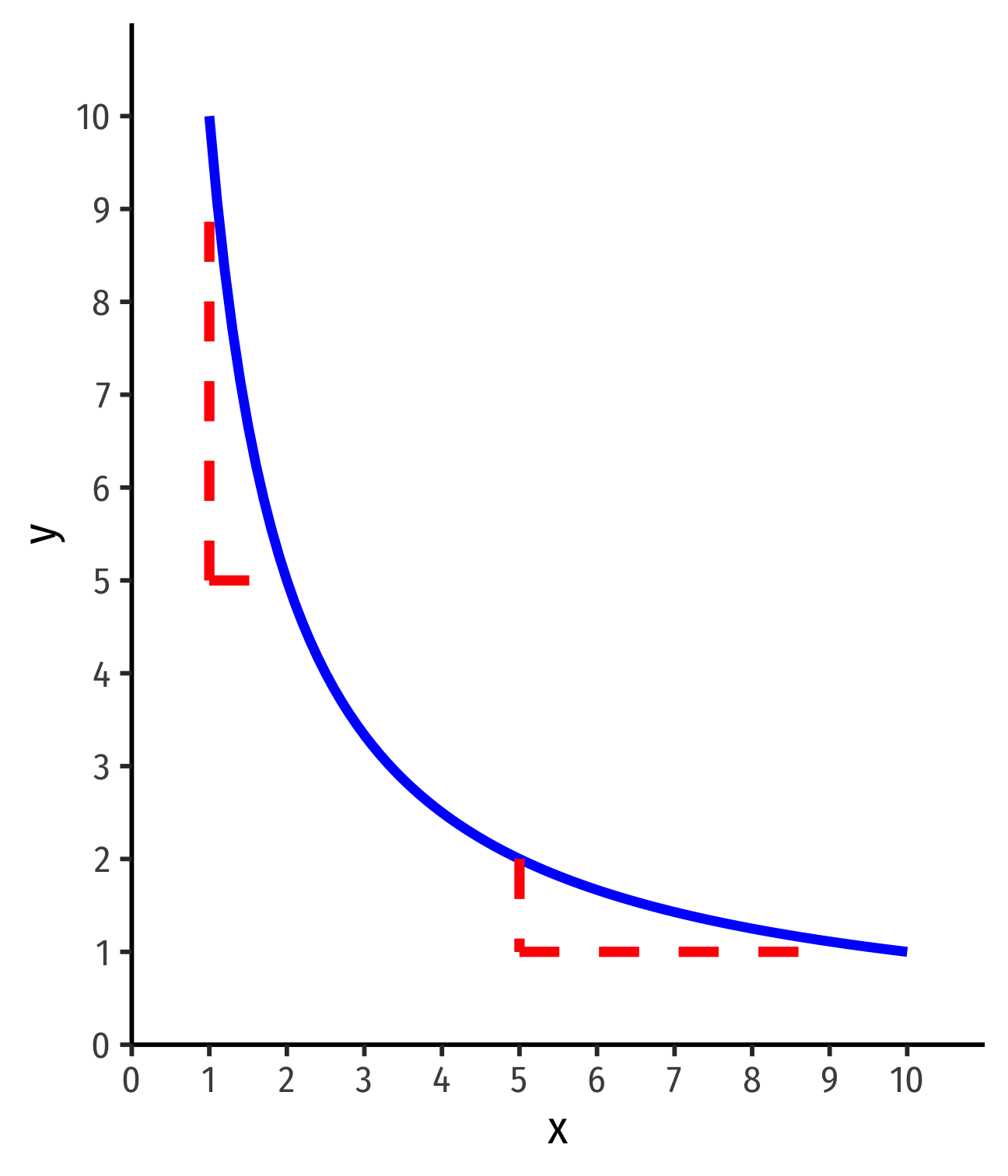
Recall: marginal rate of substitution MRSx,y is slope of the indifference curve
- Amount of y given up for 1 more x
How to calculate MRS?
- Recall it changes (not a straight line)!
- We can calculate it using something from the utility function
MRS and Marginal Utility II
- Marginal utility: change in utility from a marginal increase in consumption
MRS and Marginal Utility II
- Marginal utility: change in utility from a marginal increase in consumption
Marginal utility of x: MUx=Δu(x,y)Δx
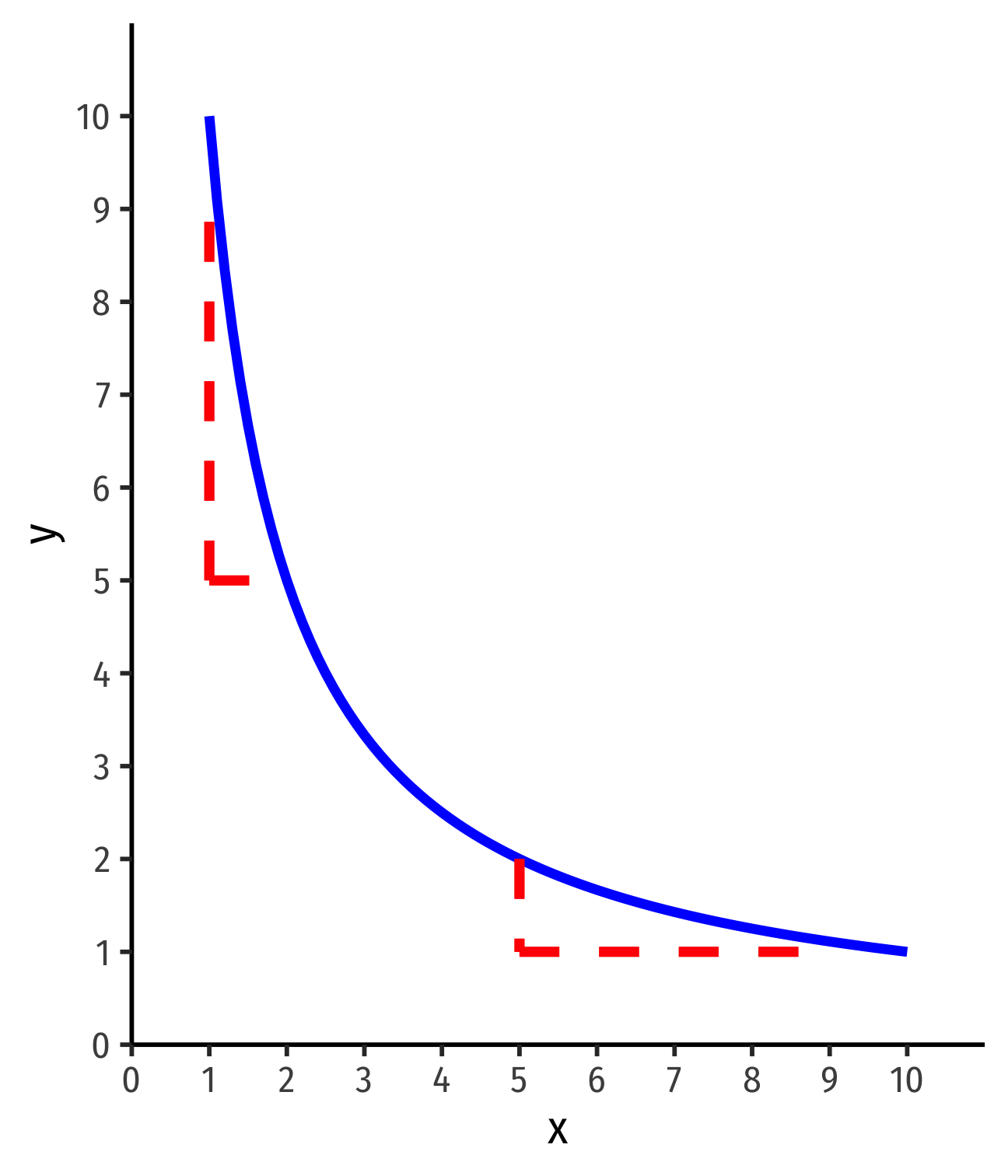
MRS and Marginal Utility II
- Marginal utility: change in utility from a marginal increase in consumption
Marginal utility of x: MUx=Δu(x,y)Δx
Marginal utility of y: MUy=Δu(x,y)Δy
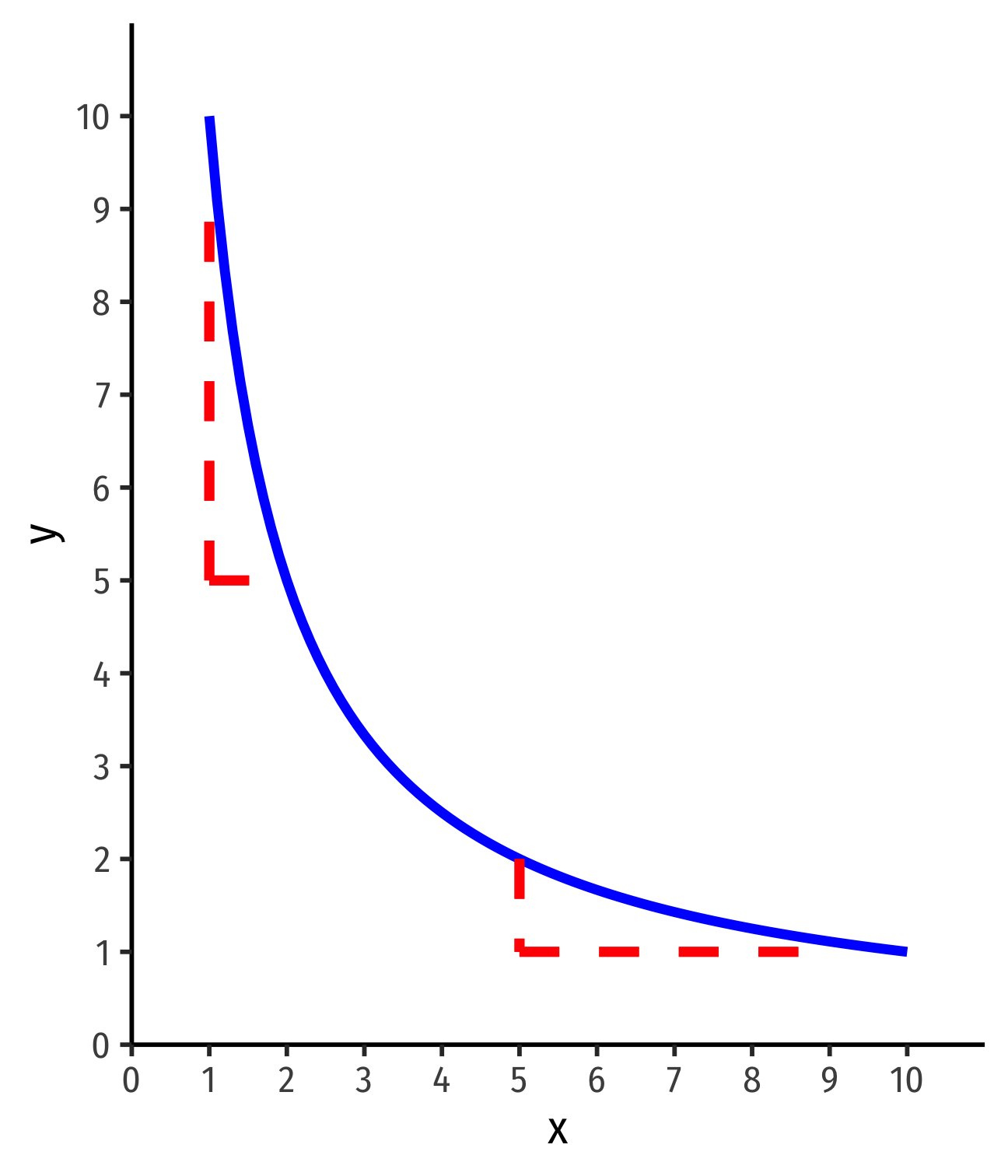
MRS and Marginal Utility II
Marginal utility: change in utility from a marginal increase in consumption
Math (calculus): "marginal" means "derivative with respect to"
- I will always derive marginal utility functions for you
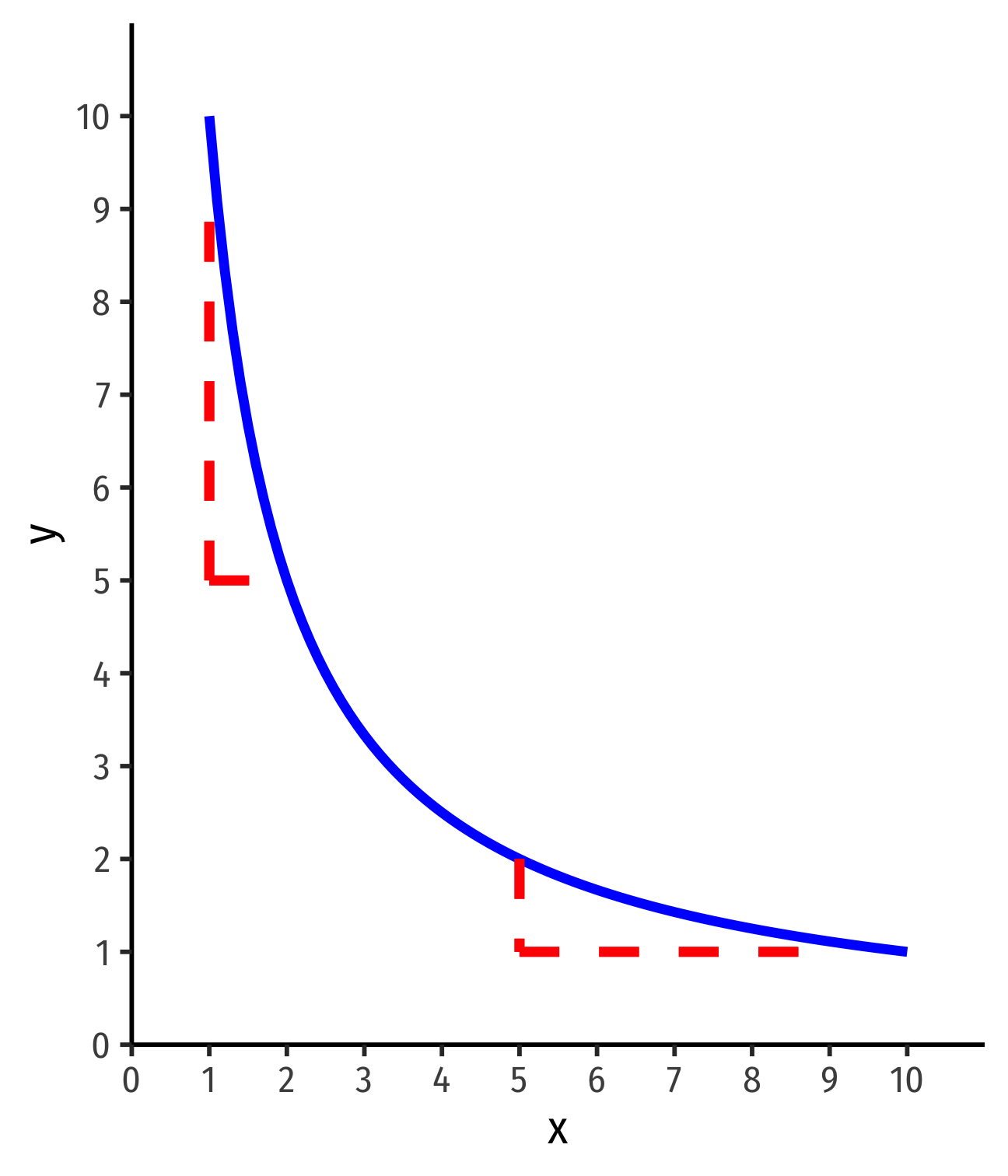
MRS and Marginal Utility III
How to relate MU and MRS?
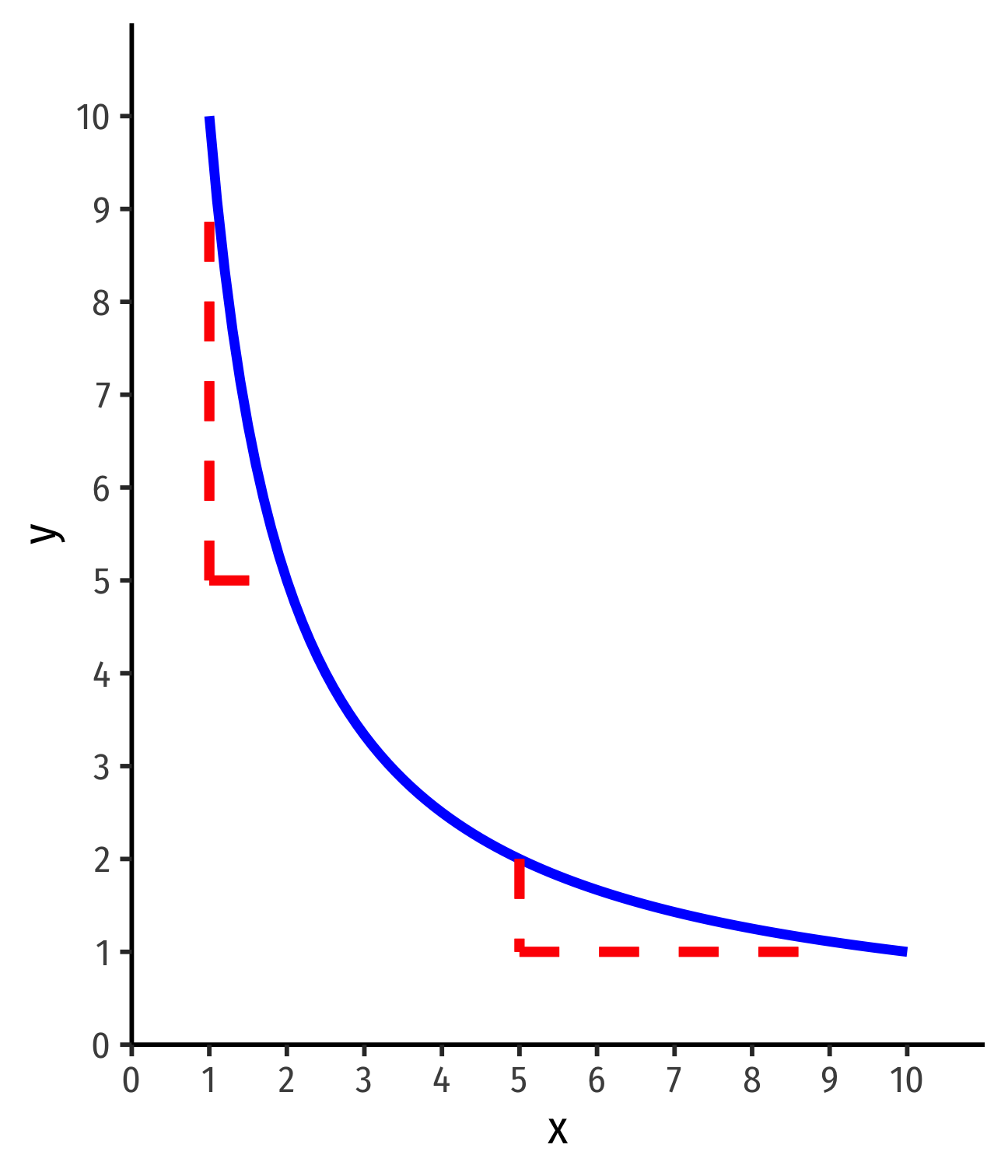
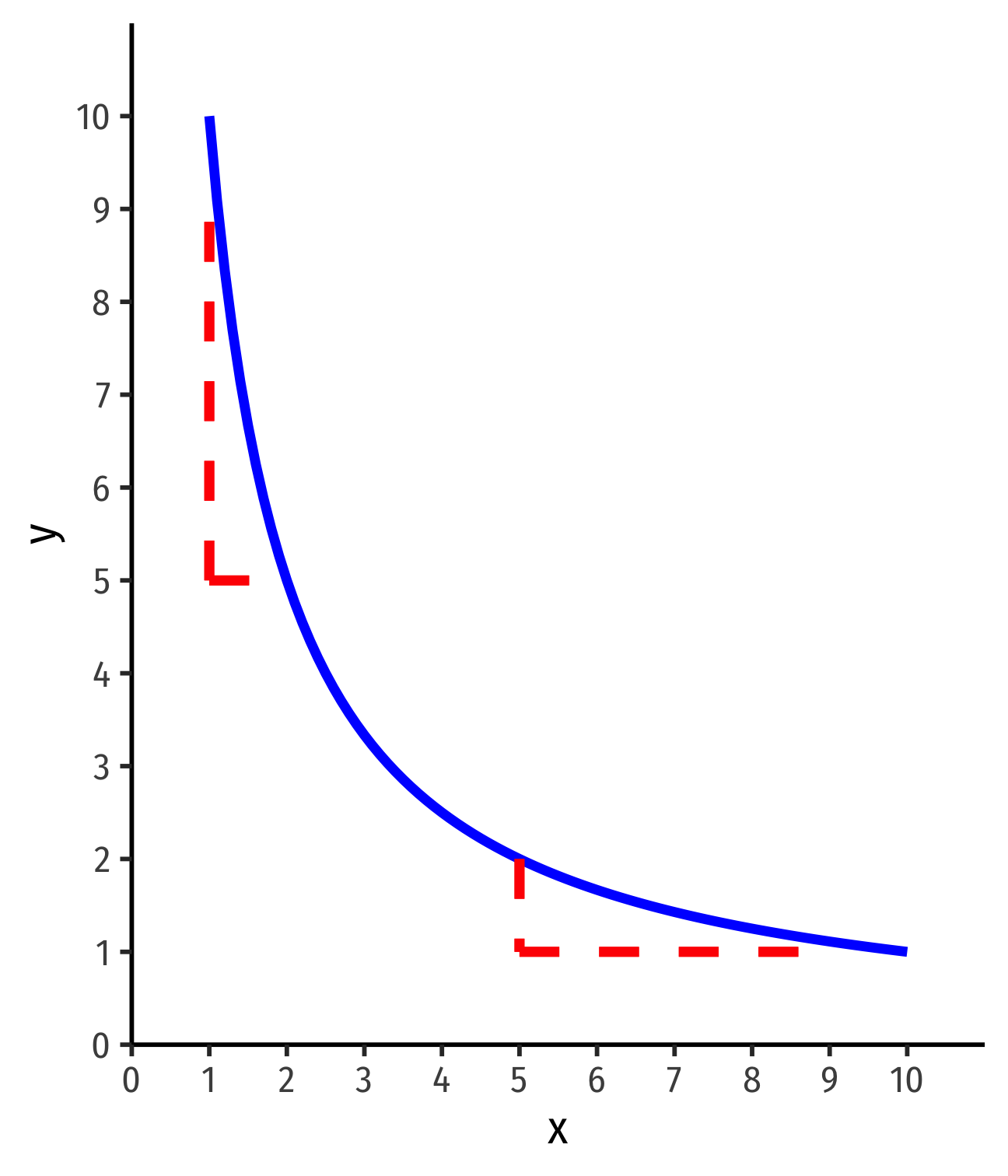
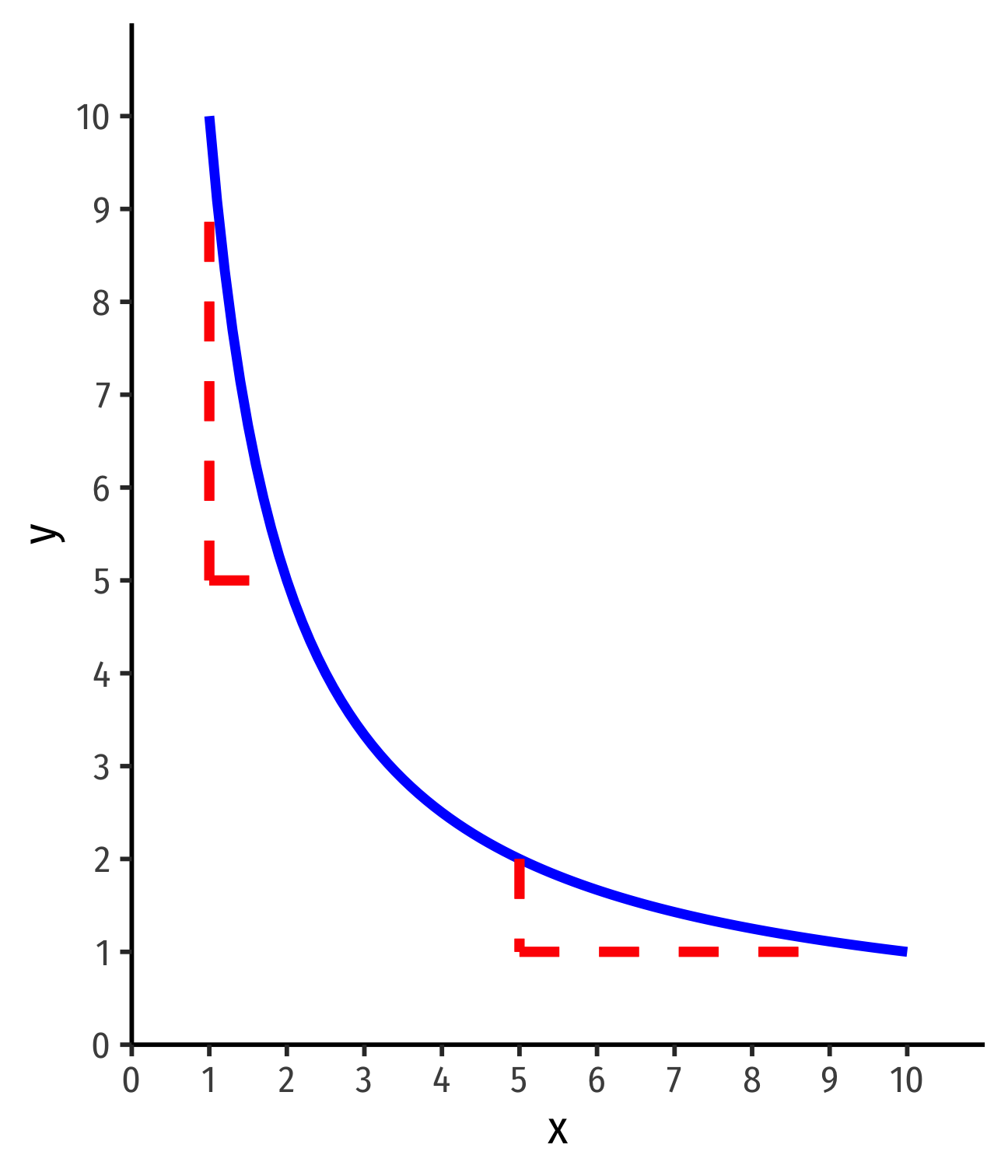
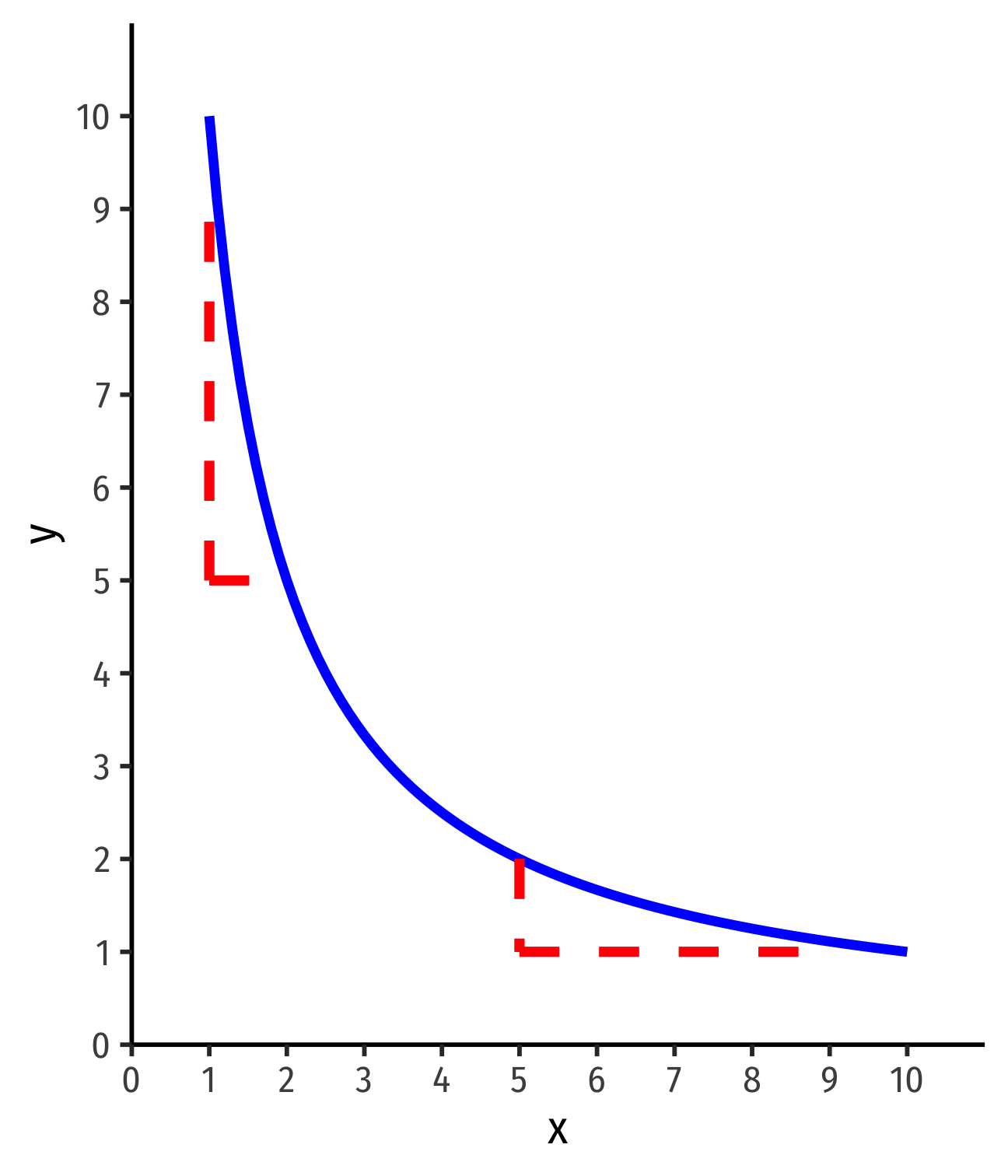
Moving along an indifference curve
- X and Y will change
- MUx and MUy will change
- Utility is constant (Δu=0)
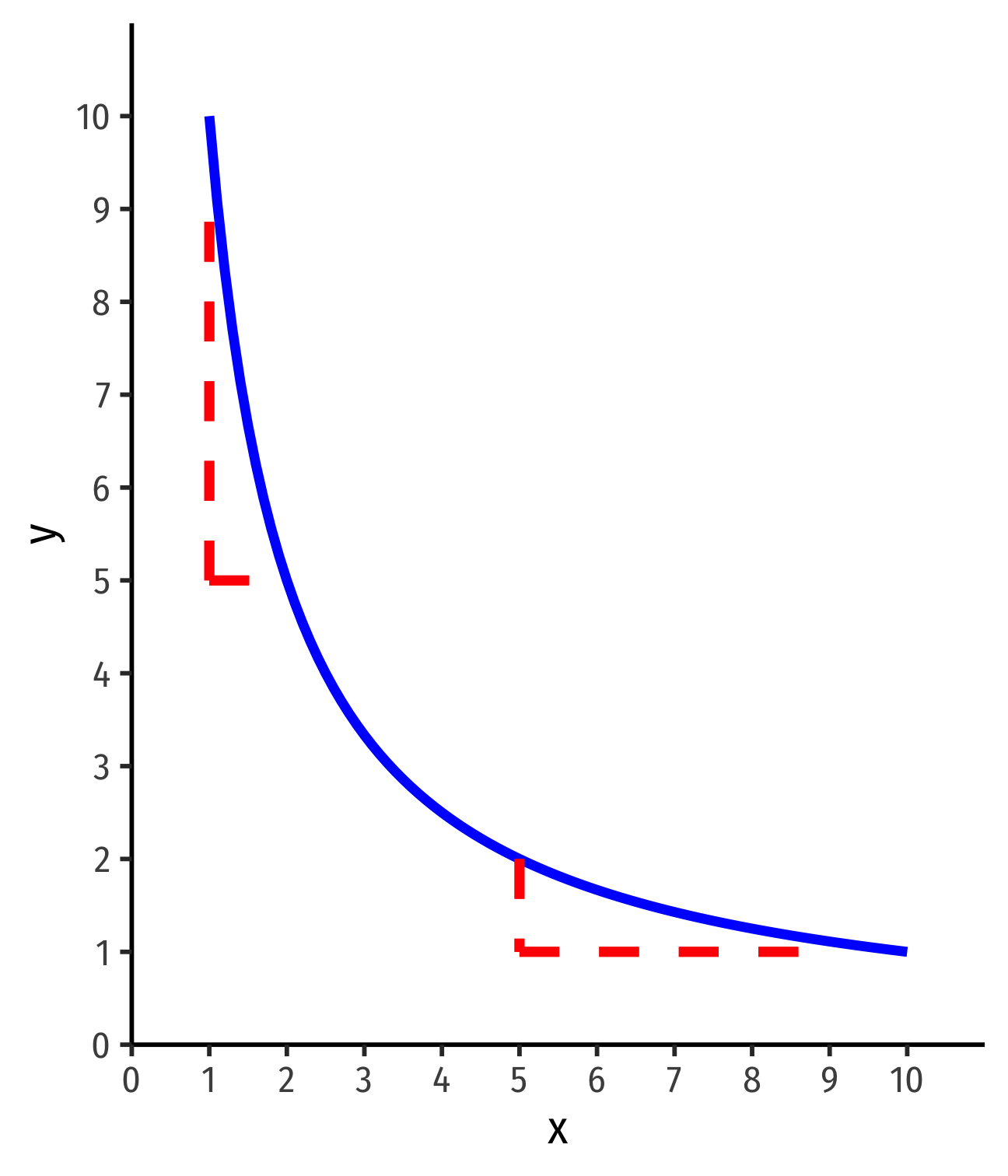
MRS and Marginal Utility IV
How to relate MU and MRS?
Moving along an indifference curve
- X and Y will change
- MUx and MUy will change
- Utility is constant (Δu=0)
MUxΔx+MUyΔy=Δu
MRS and Marginal Utility IV
How to relate MU and MRS?
Moving along an indifference curve
- X and Y will change
- MUx and MUy will change
- Utility is constant (Δu=0)
MUxΔx+MUyΔy=ΔuMUxΔx+MUyΔy=0
MRS and Marginal Utility IV
How to relate MU and MRS?
Moving along an indifference curve
- X and Y will change
- MUx and MUy will change
- Utility is constant (Δu=0)
MUxΔx+MUyΔy=ΔuMUxΔx+MUyΔy=0MUyΔy=−MUxΔx
MRS and Marginal Utility IV
How to relate MU and MRS?
Moving along an indifference curve
- X and Y will change
- MUx and MUy will change
- Utility is constant (Δu=0)
MUxΔx+MUyΔy=ΔuMUxΔx+MUyΔy=0MUyΔy=−MUxΔxΔyΔx⏟MRS=−MUxMUy
MRS and Preferences
MRS=ΔyΔx⏟slope=−MUxMUy
Observing the choices that consumers make, given their options, give us insight into their preferences
Represented in indifference curves and MRS
Steepness of indifference curves tells us how consumers trade off between goods
Let's look at extremes first
MRS and Preferences: Steepness I
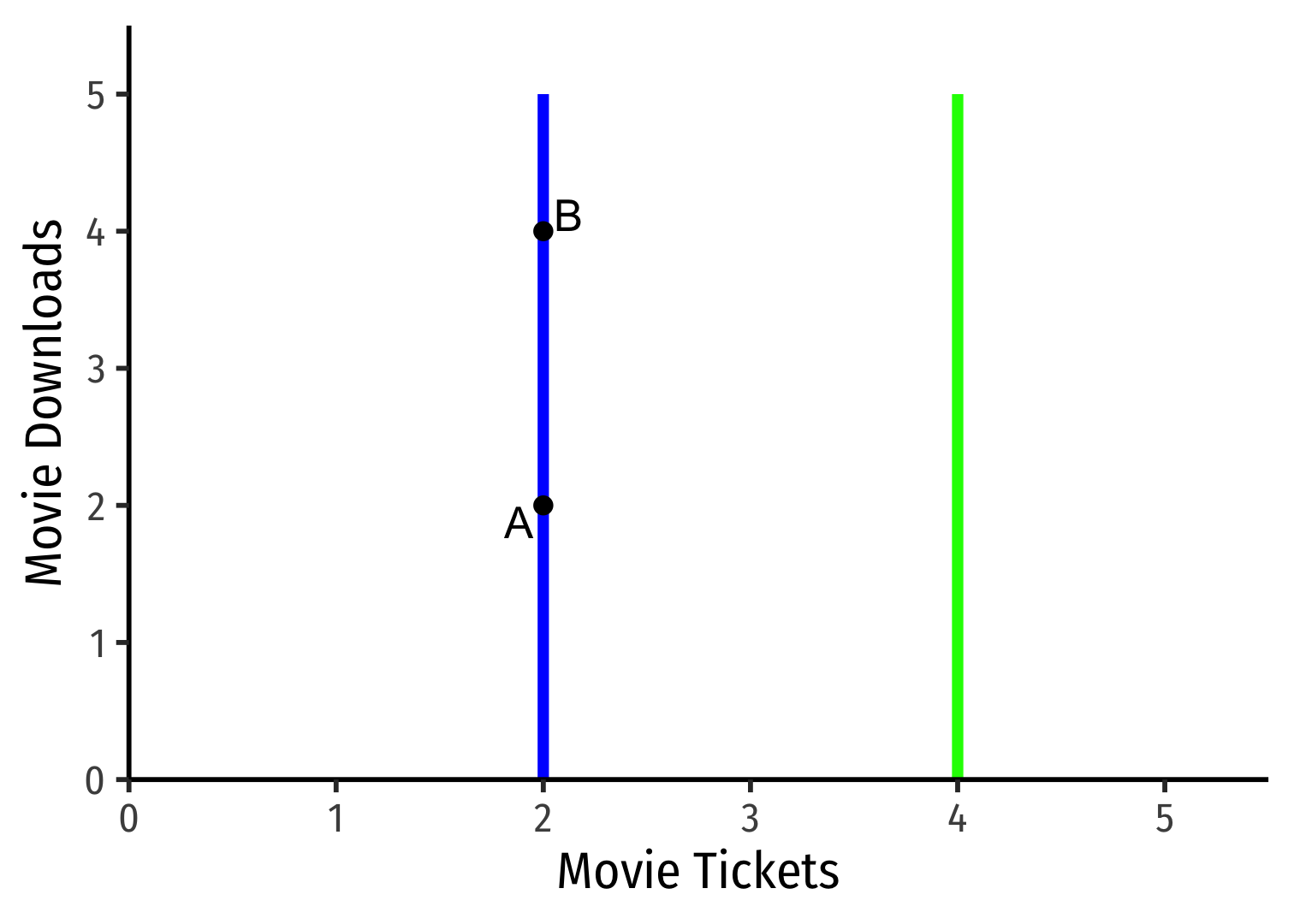
- Vertical curves ⟹ indifference between having more or less Downloads
- Downloads are a neutral
MRS and Preferences: Steepness I
- Vertical curves ⟹ indifference between having more or less Downloads
- Downloads are a neutral
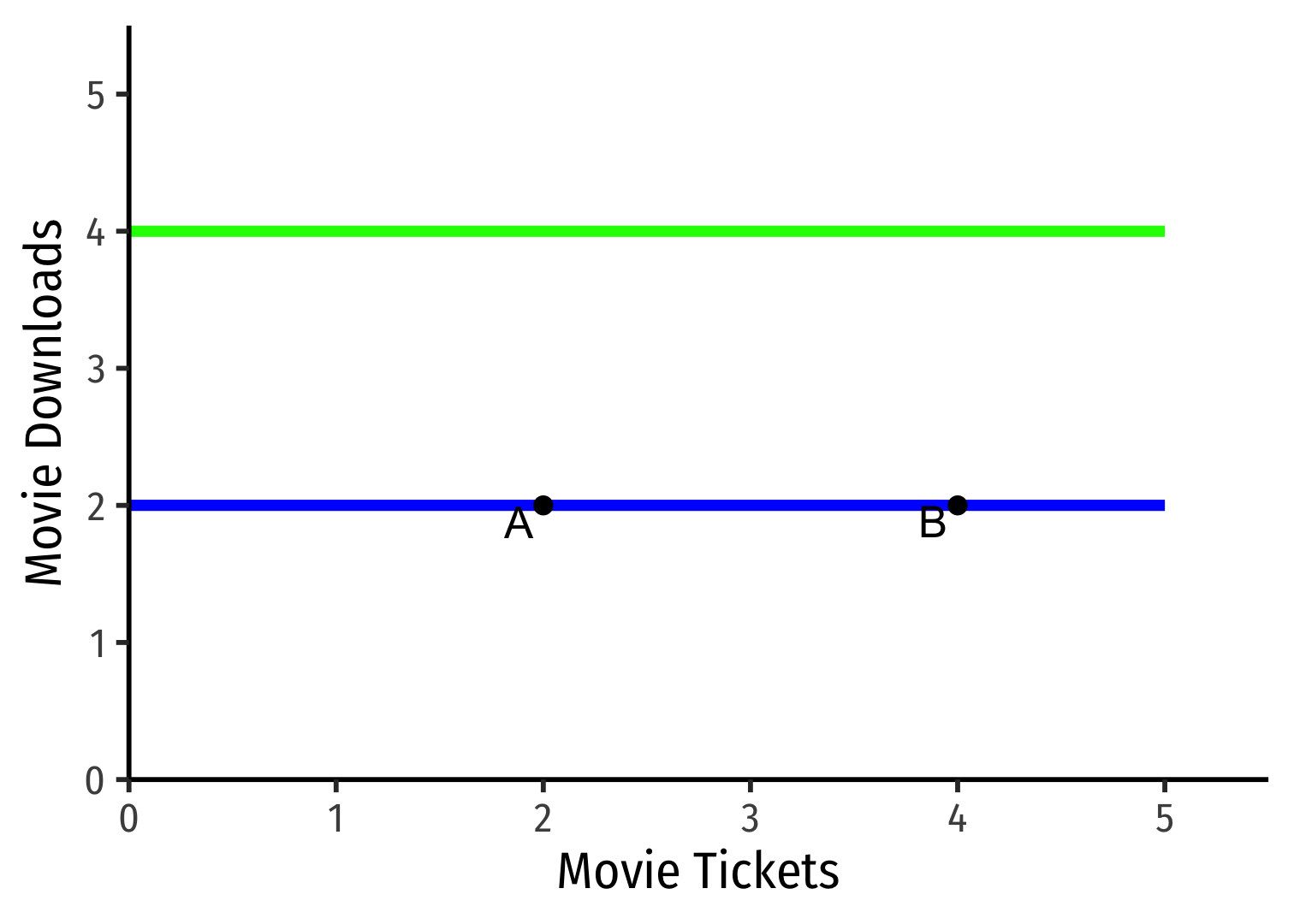
- Horizontal curves ⟹ indifference between having more or less Tickets
- Tickets are a neutral
MRS and Preferences: Steepness II
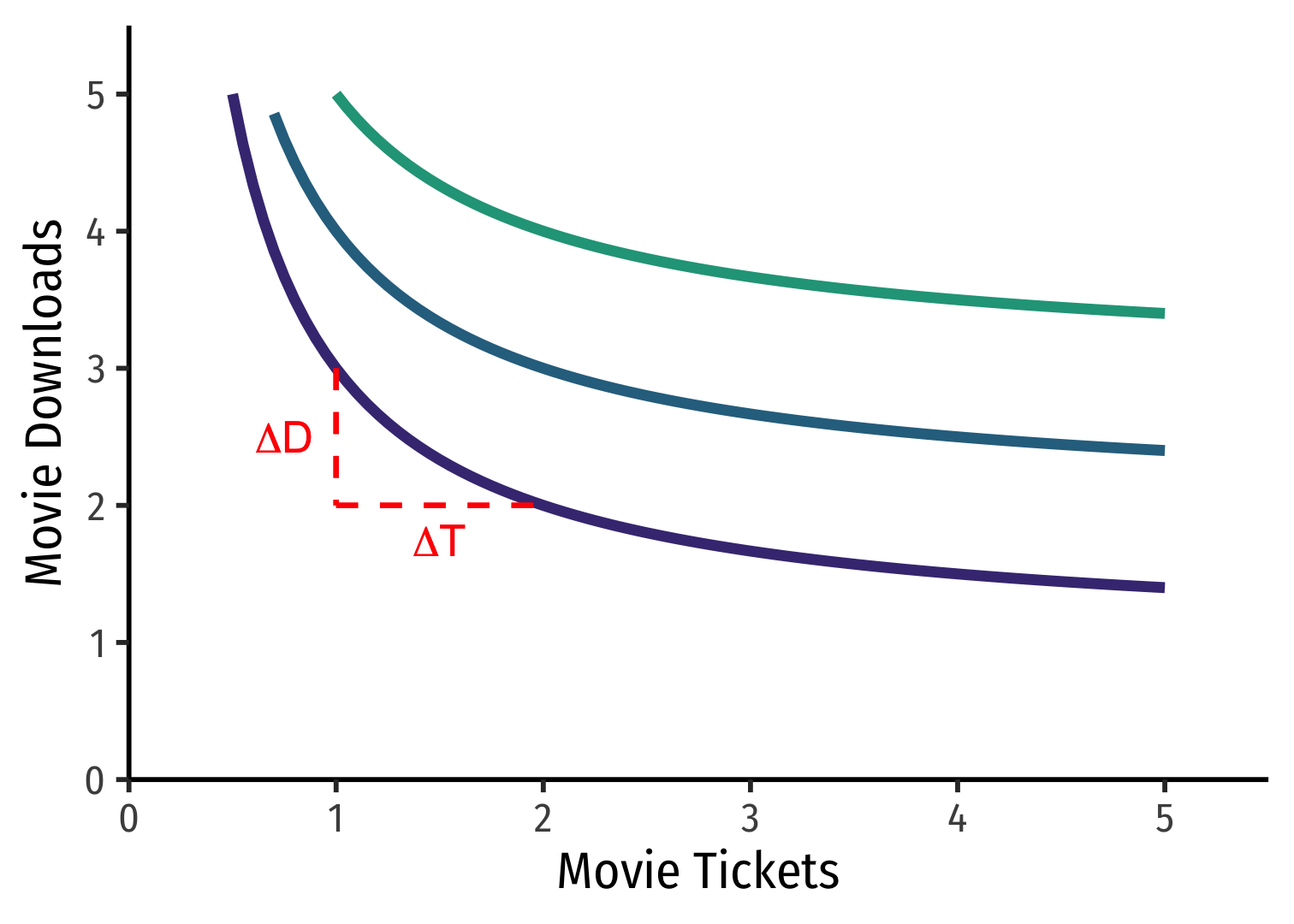
- Flatter → willing to give up few Downloads per Ticket (and vice versa)
- MRST,D is small
MRS and Preferences: Steepness II
- Flatter → willing to give up few Downloads per Ticket (and vice versa)
- MRST,D is small
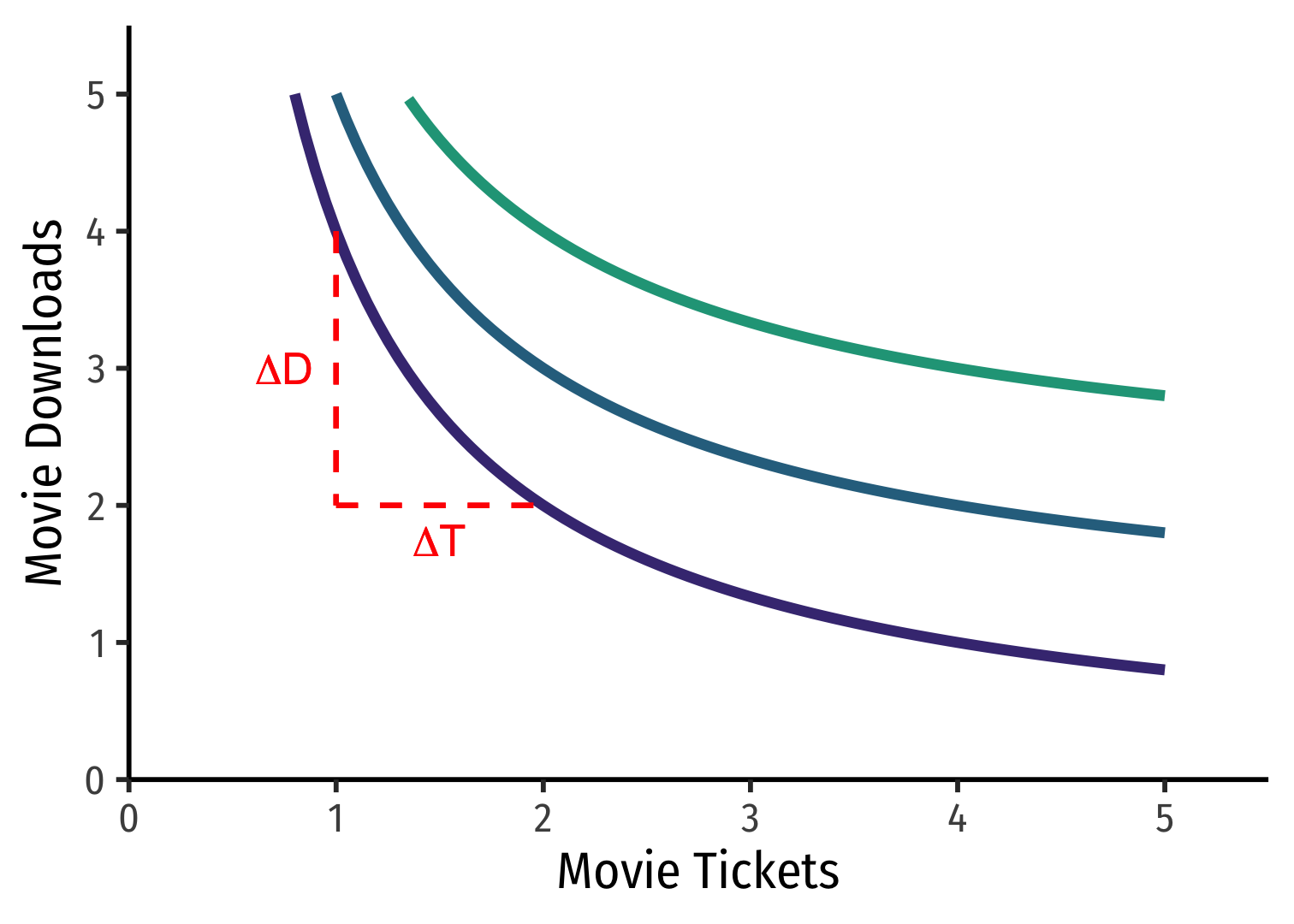
- Steeper → willing to give up more Downloads per Ticket (and vice versa)
- MRST,D is large
MRS and Preferences: Goods, Bads, Neutrals
More precise ways to classify objects:
A good enters utility function positively
- ↑ good ⟹ ↑ utility
- Willing to pay (give up other goods) to acquire more (monotonic)

MRS and Preferences: Goods, Bads, Neutrals
More precise ways to classify objects:
A good enters utility function positively
- ↑ good ⟹ ↑ utility
- Willing to pay (give up other goods) to acquire more (monotonic)
A bad enters utility function negatively
- ↑ good ⟹ ↓ utility
- Willing to pay (give up other goods) to get rid of
MRS and Preferences: Goods, Bads, Neutrals
More precise ways to classify objects:
A neutral does not enter utility function at all
- ↑,↓ has no effect on utility
MRS and Preferences: Curvature
MRS=ΔyΔx⏟slope=−MUxMUy
Curvature of indifference curves tells us how goods are related
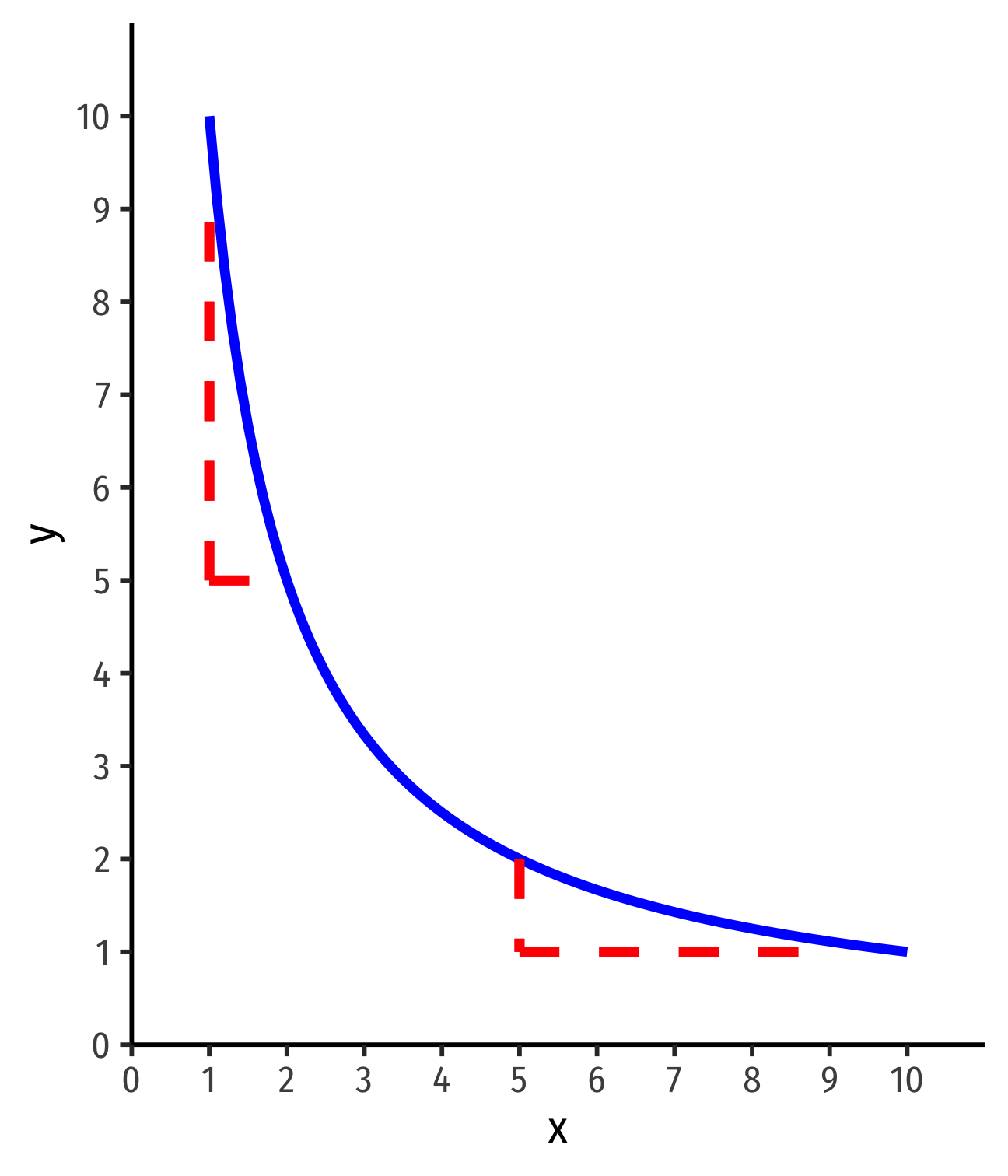
Relatively straight curves: goods are more substitutable for one another
Relatively bent curves: goods are more complementary with one another
Look at extreme cases first to see
MRS and Preferences: Curvature II
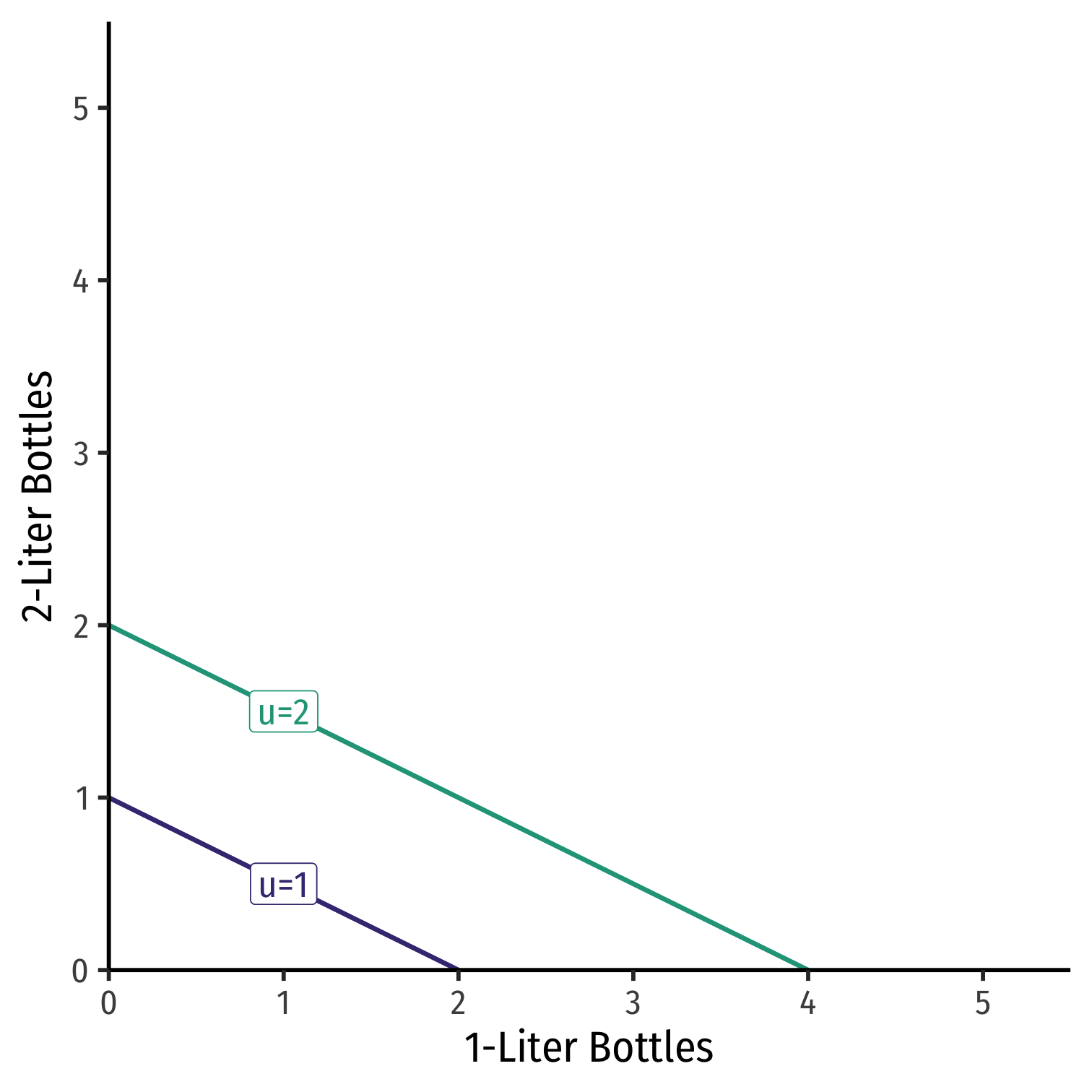
Example: Consider 1-Liter bottles of coke and 2-Liter bottles of coke
Always willing to substitute between Two 1-L bottles for One 2-L bottle
Perfect substitutes: goods that can be substituted at same fixed rate and yield same utility
MRS1L,2L=−0.5 (a constant!)
MRS and Preferences: Curvature III
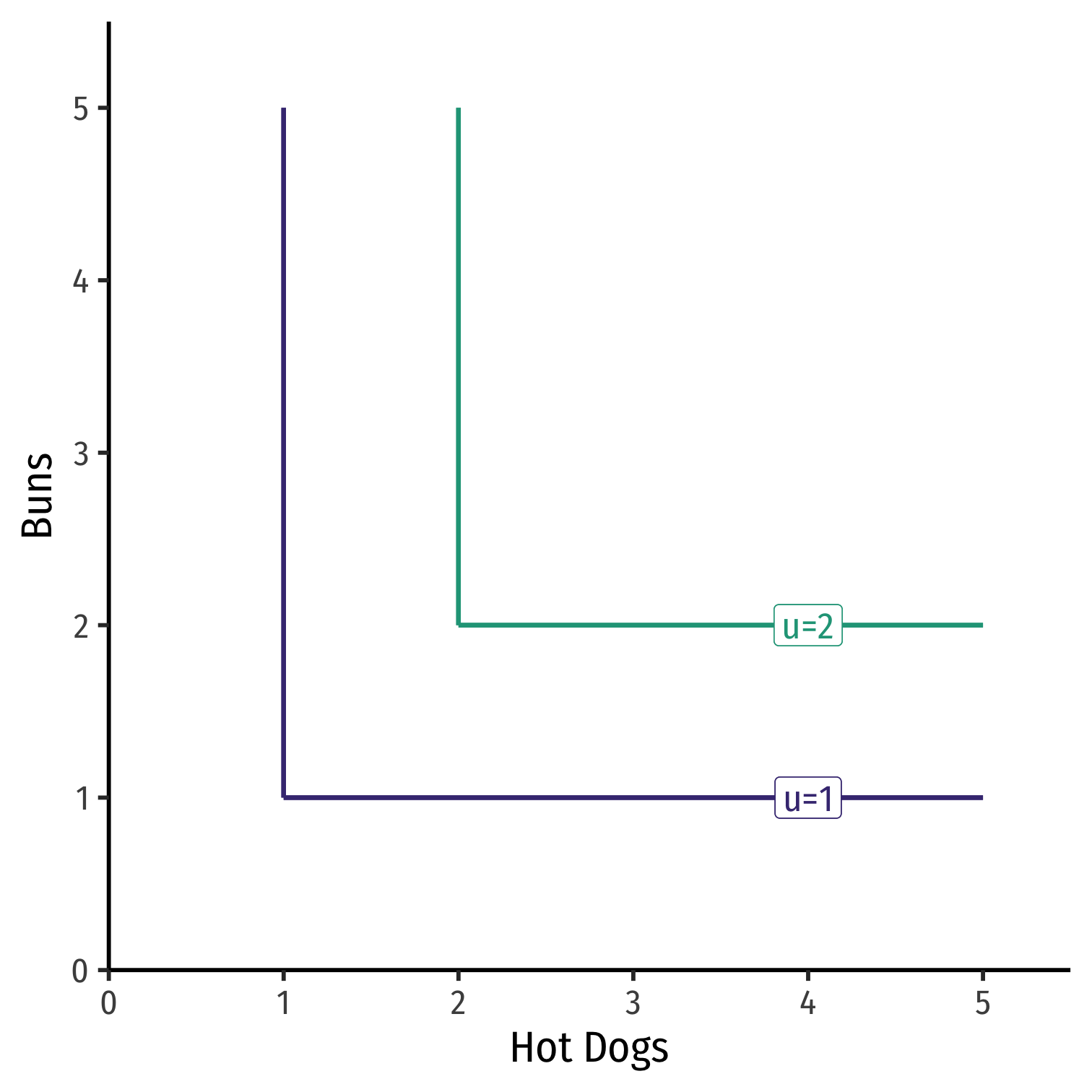
Example: Consider hot dogs and hot dog buns
Always consume together in fixed proportions (in this case, 1 for 1)
Perfect complements: goods that can be consumed together in same fixed proportion and yield same utility
(MRS_{H,B}=)?
MRS and Preferences: Curvature IV
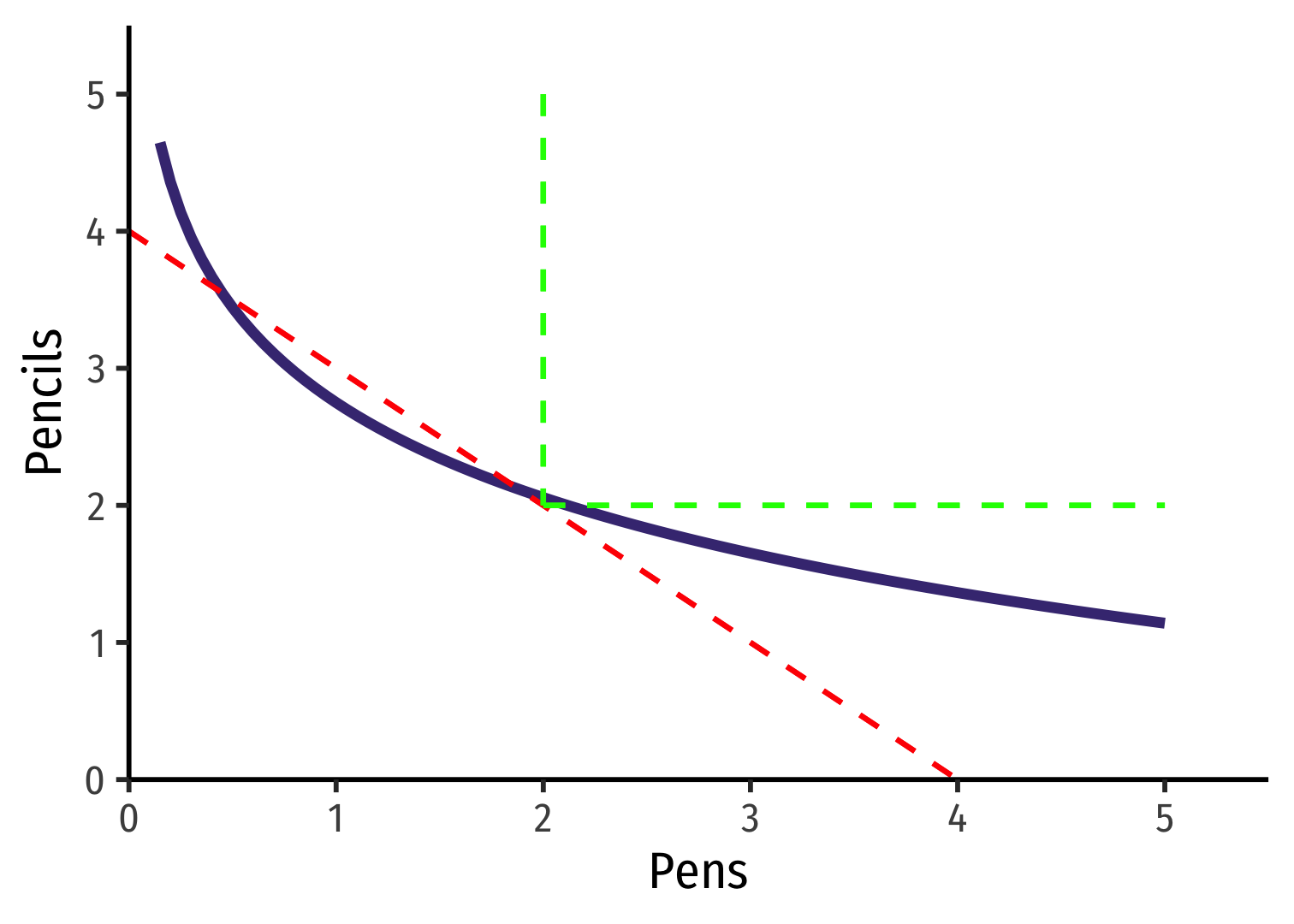
- Straighter → more substitutable
MRS and Preferences: Curvature IV
- Straighter → more substitutable
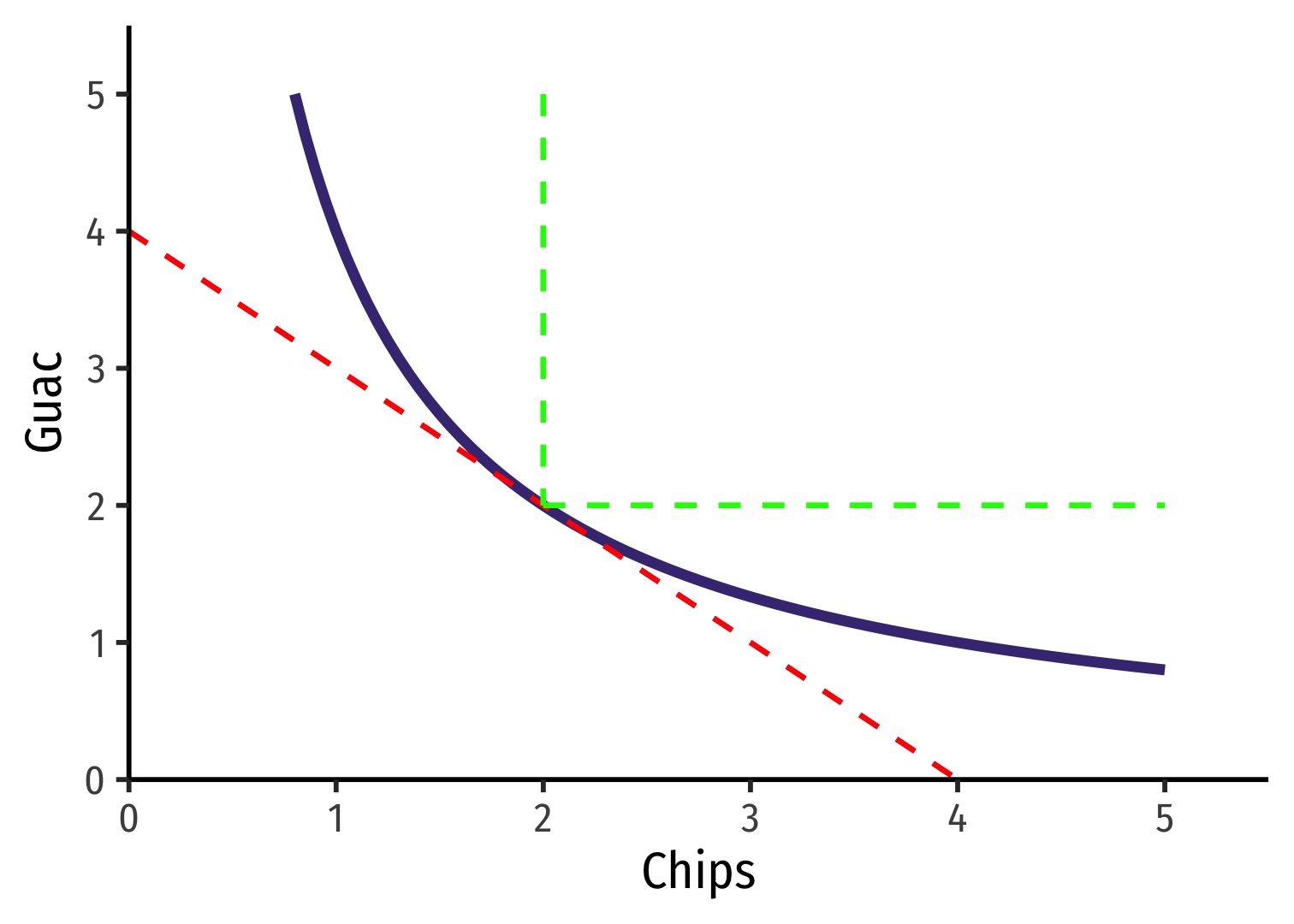
- Curved → more complementary
Cobb-Douglas Utility Functions
- A very common functional form in economics is Cobb-Douglas
u(x,y)=xayb
- Where a,b>0 (and very often a+b=1)
- Extremely useful, you will see it often!
- Strictly convex and monotonic indifference curves
- Other nice properties (we'll see later)
- See the appendix in today's class page