The Model is Not the Reality I

This course is about economic modeling and formal theory
Applications in electives (this semester):
- Industrial Organization
- Labor Economics
- Public Economics
Models help us understand reality, but they are not reality!
- Don't mistake the map for the territory itself
"All models are wrong. Some are useful" - George Box
The Model is Not the Reality II
Our models so far have given us interesting results,
- Markets reach equilibrium
- Economic profits are zero in the long run in competitive markets
Both are fictional
But the models still show us useful insights about how a market economy works
Some readings in today's readings page to help you understand
The Model is Not the Reality II

The Law of One Price I
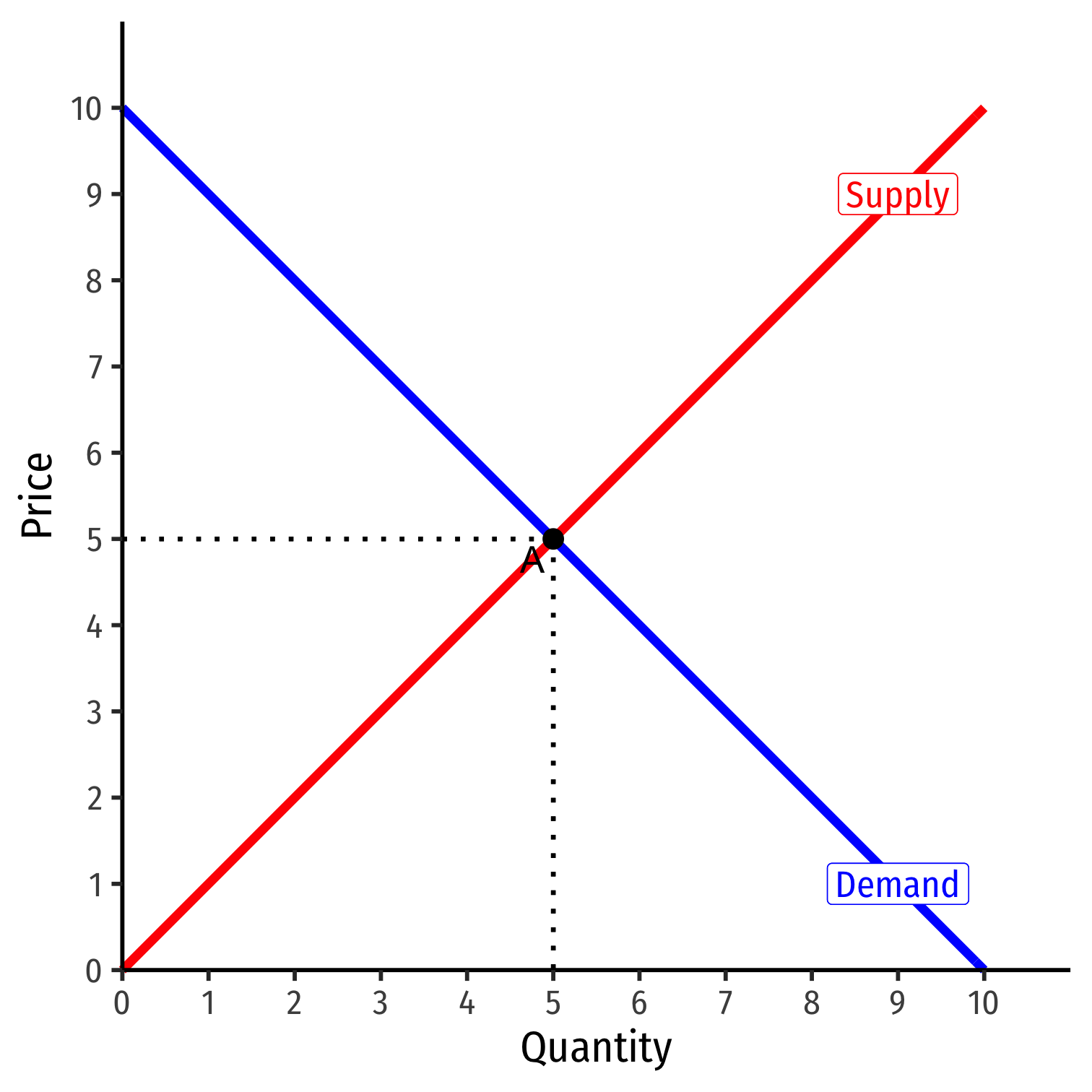
- Law of One Price: all units of the same good exchanged on the market will tend to have the same market price (the market-clearing price, p∗)
The Law of One Price II

Consider if there are multiple different prices for same good:
Arbitrage opportunities: optimizing individuals recognize profit opportunity:
- Buy at low price, resell at high price!
- There are possible gains from trade or gains from innovation to be had
Entrepreneurship: recognizing profit opportunities and entering a market as a seller to try to capture gains from trade/innovation
Arbitrage and Entrepreneurship I

Entrepreneurship

Mark Zuckerberg
1984-
"Why were we the ones to build [Facebook]? We were just students. We had way fewer resources than big companies. If they had focused on this problem, they could have done it. The only answer I can think of is: we just cared more. While some doubted that connecting the world was actually important, we were building. While others doubted that this would be sustainable, we were forming lasting connections."
How Markets Get to Equilibrium I

Nobody knows "the right price" for things
Each Buyer and Seller only knows their own reservation prices
Buyers and sellers adjust their bids/asks
Markets do not start competitive, but monopolistic!
New entrepreneurs enter to try to capture gains from trade/innovation
As these gains are exhausted, prices converge to equilibrium
How Markets Get to Equilibrium II

Errors and imperfect information ⟹ multiple prices
- ⟹ arbitrage opportunities ⟹ entrepreneurship
- ⟹ correcting mistakes ⟹ people update their behavior & expectations
Markets are discovery processes that discover the right prices, the optimal uses of resources, and cheapest production methods, none of which can be known in advance!
How Markets Get to Equilibrium III

Economy as a cat-and-mouse game between:
- "Underlying variables": preferences, technology, and resource availability
- "Induced variables": market prices, least-cost technologies
Induced variables always chasing underlying variables
- Underlying variables always changing
- Any time underlying ≠ induced variables: profit opportunities
IF underlying variables froze, market would rest at equilibrium
The Origins of Exchange I
Why do we trade?
Resources are in the wrong place!
People have better uses of resources than they are currently being used!

The Origins of Exchange II
Why are resources in the wrong place?
We have the same stuff but different preferences

The Origins of Exchange III
Why are resources in the wrong place?
We have different stuff and different preferences


Transaction Costs and Exchange I
- But Transaction costs!
- Search costs: cost of finding trading partners
- Bargaining costs: cost of reaching an agreement
- Enforcement costs: trust between parties, cost of upholding agreement, dealing with unforeseen contingencies, punishing defection, using police and courts

Transaction Costs and Exchange II
With high transaction costs, resources cannot be traded
Resources cannot be switched to higher-valued uses
If others value goods higher than their current owners, resources are inefficiently allocated!
Transaction Costs and Exchange III

Markets are institutions that facilitate voluntary impersonal exchange and reduce transaction costs
There's a lot of institutions in the "bundle" we call "markets":
- Prices, profits and losses, property rights, rule of law, contract enforcement, dispute resolution, protection, trust
Transaction Costs and Exchange III
All of those things are assumed when we draw nice supply & demand graphs on the blackboard
Other PSCI/ECON courses: how do various political institutions enable these market institutions to succeed?
Social Problems that Markets Solve Well

Problem 1: Resources have multiple uses and are rivalrous
Problem 2: Different people have different subjective valuations for uses of resources
It is inefficient (immoral?) to use a resource in a way that prevents someone else who values it more from using it!
Social Problems that Markets Solve Well
Solution: Prices in a functioning market accurately measure opportunity cost of using resources in a particular way
The price of a resource is the amount someone else is willing to pay to acquire it from its current use/owner
Markets and Pareto Efficiency
Voluntary exchange is a Pareto improvement: change in allocation that makes at least one person better off and making nobody worse off
An allocation of resources is Pareto efficient when there are no possible Pareto improvements

Market Efficiency in Competitive Equilibrium I
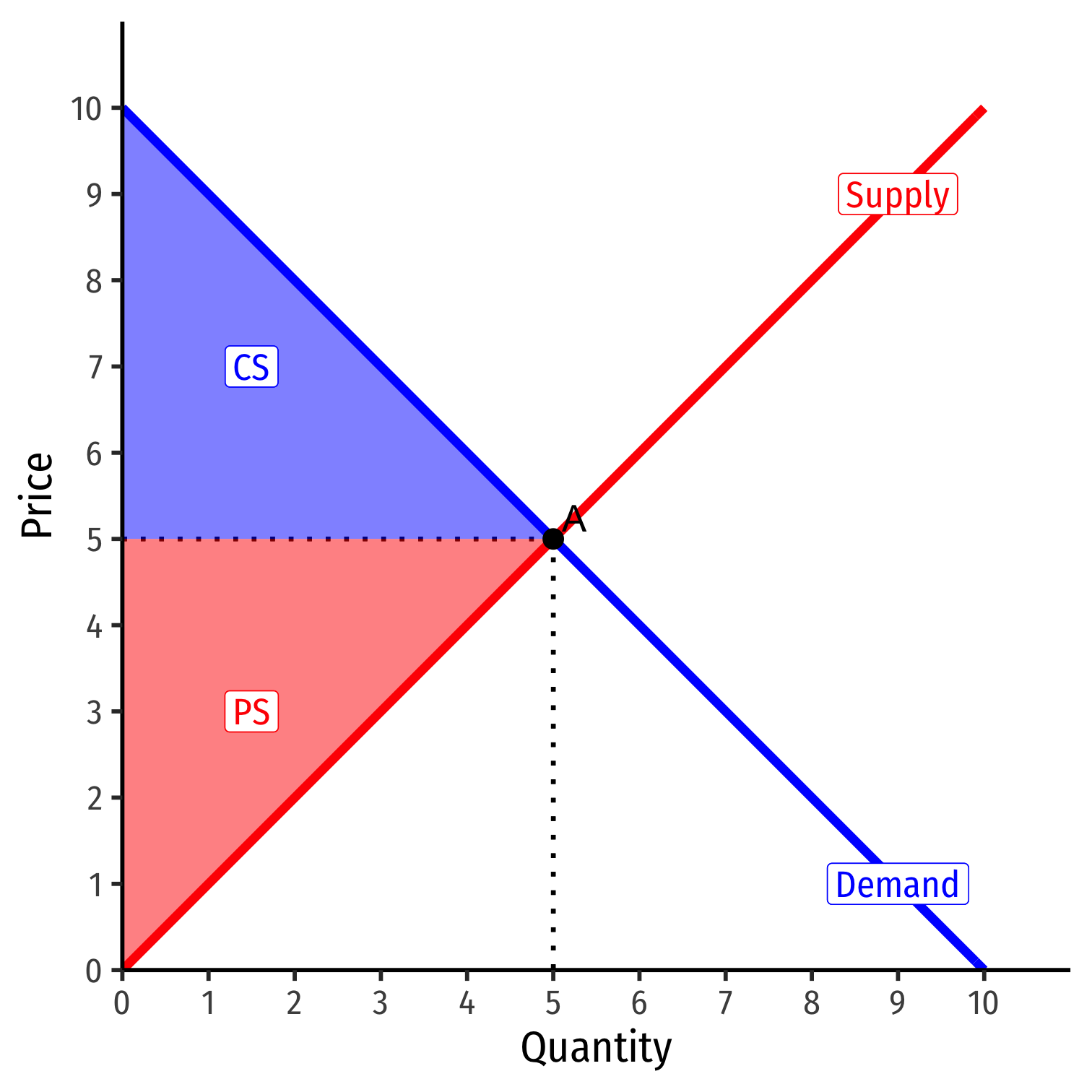
Allocative efficiency: resources are allocated to highest-valued uses
- Goods produced up to the point where MB=MC (p=MC)
Pareto efficient: no possible Pareto improvements exist
All potential gains from trade are fully exhausted
Market Efficiency in Competitive Equilibrium II
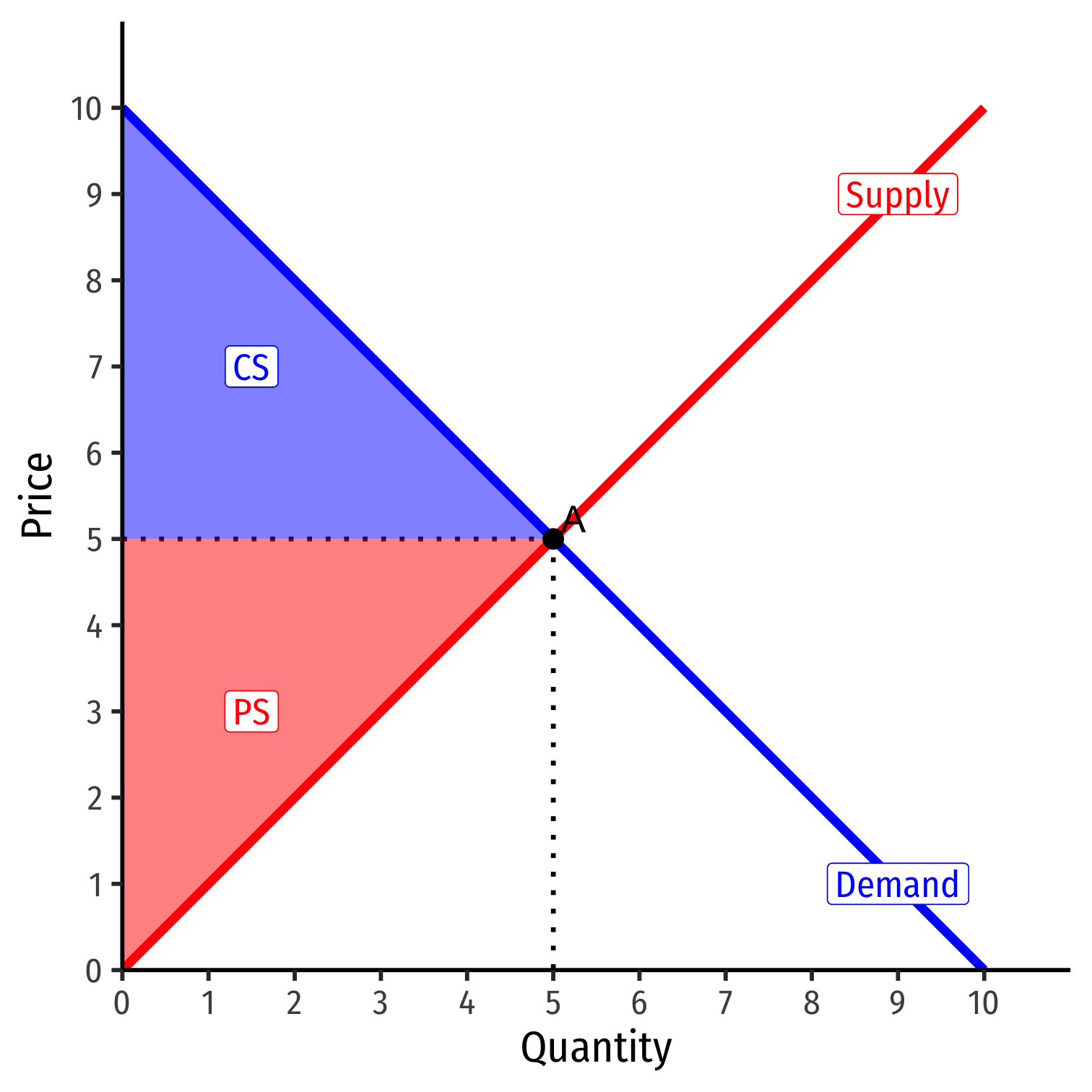
Economic surplus = Consumer surplus + Producer surplus
Maximized in competitive equilibrium
Resources flow away from those who value them the lowest to those that value them the highest
The social value of resources is maximized by allocating them to their highest valued uses!
Prices are Signals I
Prices are Signals II

Markets are social processes that generate information via prices
Prices are never "given", prices emerge dynamically from negotiation and market decisions of entrepreneurs and consumers
Competition: is a discovery process which discovers what consumer preferences are and what technologies are lowest cost, and how to allocate resources accordingly
The Social Functions of Prices I

A relatively high price:
Conveys information: good is relatively scarce
Creates incentives for:
- Buyers: conserve use of this good, seek substitites
- Sellers: produce more of this good
- Entrepreneurs: find substitutes and innovations to satisfy this unmet need
The Social Functions of Prices II

A relatively low price
Conveys information: good is relatively abundant
Creates incentives for:
- Buyers: substitute away from expensive goods towards this good
- Sellers: Produce less of this good, talents better served elsewhere
- Entrepreneurs: talents better served elsewhere: find more severe unmet needs
Uncertainty, Tacit Information, and Profit I
Economic theory: in a perfectly competitive market, in the long run, economic profit → to zero
Real world: there are often economic profits
Our blackboard models assume perfect information
In reality we have to deal with uncertainty
Uncertainty, Tacit Information, and Profit II
People don't know what the right price is: mispricing and multiple prices → arbitrage/profit opportunities
- Some people recognize opportunities ($20 bills) that others do not see
In a world of certainty, there would be no profit

Reminder: Profits and Entrepreneurship

In markets, production faces profit-test:
- Is consumer's willingness to pay > opportunity cost of inputs?
Profits are an indication that value is being created for society
Losses are an indication that value is being destroyed for society
Survival for sellers in markets requires firms continually create value and earn profits or die
Why We Need Prices, Profits, and Losses I

People often confuse the economic problem with a technological problem
Technological problem: how to allocate scarce resources to accomplish a particular goal
- e.g. buy the right combination of goods to maximize utility
- e.g. buy the right combination of inputs and produce output to maximize profits
- given stable prices, preferences, and technologies, a computer can solve this problem
Why We Need Prices, Profits, and Losses II
Economic calculation problem: how to determine which of the infinite technologically-feasible options are economically viable?
How to best make use of dispersed knowledge to coordinate conflicting plans of individuals for their own ends?
ONLY through competition, prices, profits, and losses

So What's the Point of the Model?
In perfect competition (model):
- price-taking firms set price equal to marginal cost
- long run economic profits are zero
- allocative efficiency: consumer and producer surplus maximized
This is a tendency only because of free entry and exit

So What's the Point of the Model?
In perfect competition (model):
- price-taking firms set price equal to marginal cost
- long run economic profits are zero
- allocative efficiency: consumer and producer surplus maximized
This is a tendency only because of free entry and exit
Don't judge real world markets by their similarity to "perfect competition," judge on contestability or ease of entry!